Not another cost dashboard.
The system that closes the work.
Built for startup CTOs and platform leads without a full FinOps team. OpsCurb turns AWS waste into assigned, tracked, escalated work — and keeps it visible until someone actually closes it.
Connect the Core Scan Role, review the first queue, and see what your team needs to own — in under 10 minutes. No agents to install.
Watch the first proof path
A short redacted hero loop: connect AWS, reach the first-scan brief quickly, and show the path from insight to accountable follow-through.
Short hero loop. Open the product tour for the full walkthrough.
“We knew there was waste. We just never had a way to turn it into something someone actually owned. OpsCurb gave us that — first scan to ticket in under a day.”
$1,097 saved
Tracked since February 2026
138 resolved findings
Actions already closed
387 actionable findings
Work still visible in queue
~$618/mo identified
Approximate current monthly upside
Anonymized pilot data — real logos and testimonials added as customers approve public use. Read the full case study
See the first-scan brief before you trust the claims
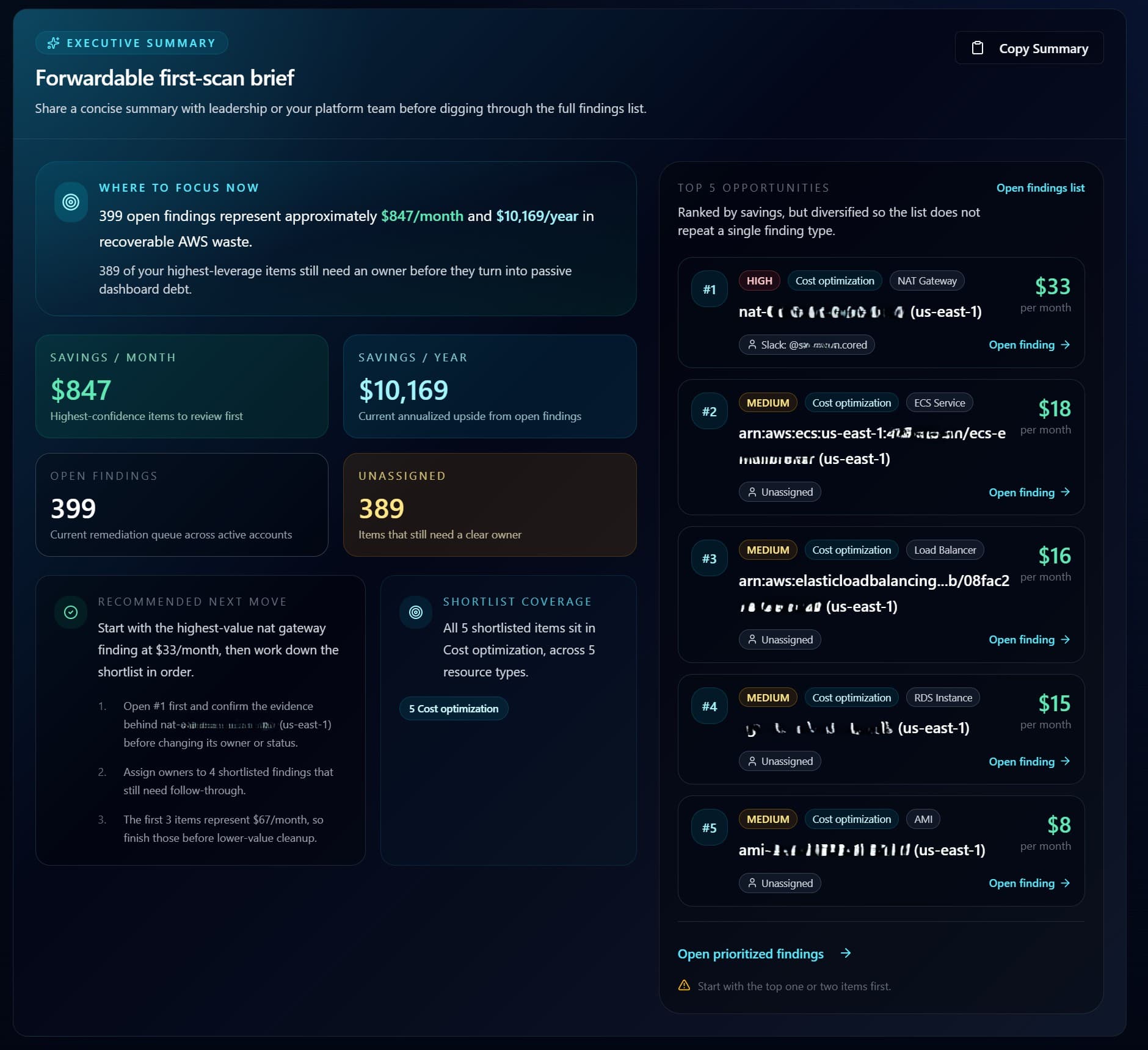
This is a redacted real screen from OpsCurb. It shows how the first scan surfaces the Top 3 actions, owner gaps, overdue work, and practical next steps before you open the full tour.
Top 3 actions first
Estimated impact ranked with overdue and ownership signals.
Owner + overdue visible
Leadership can see what is stuck, unassigned, or already moving.
Next steps clear
Teams can see what to verify and act on next.
 Sample report
A first-scan brief you can assign, track, and forward
Most cloud cost tools stop at a savings number. Your first scan produces a concise executive summary, a ranked action queue, and owner-ready remediation guidance. See the product tour.
Sample first-scan brief
Executive Summary
In a typical $5,000/mo account, this first scan surfaced about $424/mo in recurring, low-risk waste. That is enough to matter, but still believable for a first pass focused on obvious cleanup and storage tuning. The point is not just the detections. The report also shows exact resource IDs, accounts, and regions so the team can recognize the work immediately. The first actions stay visible first: one is overdue, one is escalated, and one still needs an owner. Leadership can see what is owned, what is stuck, and what needs follow-through before the next scan.
Sample resource records
What the actual report talks about
Exact resource IDs, accounts, regions, and monthly impact make the sample feel like a real output.
Idle development database
$138/mo
atlas-dev-postgres
atlas-platform-dev • us-east-1
Single-AZ dev database with no recent connections. Snapshot first, then stop and remove if the workload is no longer needed.
S3 traffic still traverses NAT
$71/mo
nat-prod-egress-a
atlas-network-prod • us-east-1
Gateway endpoint traffic would remove the route cost for this workload and keep the egress path visible in the report.
Endpoint spread across 3 AZs
$21.90/mo
vpce-ecr-dkr-3az
atlas-platform-prod • us-east-1
The report keeps the resource ID, region, and AZ footprint visible so the team can remove only the extra endpoint capacity.
Retention drift on debug logs
$33/mo
/aws/ecs/atlas-api-prod
atlas-app-prod • us-west-2
Audit-facing logs can stay longer, while noisy debug streams are trimmed so the resource-level cost story stays easy to follow.
Ranked action queue
Overdue → unassigned → monthly impact#1 priority
Idle RDS development instance
Confirm no connections for 14 days, take a final snapshot, then stop and remove the single-AZ dev instance in the next change window.
$138/mo
Owner: Platform
#2 priority
NAT route to S3 still pending
Route S3 traffic through a gateway endpoint, validate data-path performance, then remove the NAT path for that workload.
$71/mo
Owner: Networking
#3 priority
ECR DKR interface endpoint in 3 AZs
Confirm no service still depends on the endpoint DNS path, then remove the interface endpoint or keep it if the image pull path is still required.
$21.90/mo
Owner: Platform
#4 priority
CloudWatch retention drift
Assign the owner, move noisy debug groups to 7-day retention, and keep audit-oriented logs at 30 days.
$33/mo
Owner: Unowned
#5 priority
Storage cleanup batch in 3 regions
Confirm no point-in-time recovery dependency, then delete 11 orphaned gp2 volumes and 6 stale AMI snapshots in one cleanup batch.
$94/mo
Owner: Infra
#6 priority
gp2 migration backlog
Start with 4 low-risk 150-300GB gp2 volumes in dev and staging, migrate to gp3, then re-run performance validation before queue expansion.
$88/mo
Owner: App team
Lifecycle snapshot
Assigned → overdue → escalated → resolved or snoozed. This is the workflow layer, not just a list of cleanup checks.
2
findings in this state
1
findings in this state
1
findings in this state
1
findings in this state
What this proves
- Overdue or unowned waste is obvious before it slips back into backlog debt.
- Each action shows who owns it and what should happen next.
- Leadership can forward a short summary and see what still needs escalation.
Ready to see your own first queue?
Run the free scan first. Guided review is optional if you want help validating the first pass live.